Prevention Guide
Drainage and Grading: The Cheapest Foundation Work There Is
Almost every foundation problem in this county is a water problem wearing a different hat. This is the guide to the least glamorous and most cost-effective work available, and the reason it belongs before anything expensive.
Soil behaves predictably under load when its moisture content is stable, and unpredictably when it swings. That single sentence explains most of what happens to foundations in Leon County, on both sides of the Cody Scarp, and it explains why the damage so reliably appears on one side of a house rather than uniformly around it.
Tallahassee takes close to fifty-nine inches of rain a year. June is the wettest month at around seven and three quarter inches, November the driest at about three, and much of the summer total arrives in intense storms rather than gentle soaking. Every one of those storms is a decision point about where a very large volume of water goes.
The mechanism, on each side of the scarp
North of the Cody Scarp, in the Red Hills, concentrated water swells clay-bearing soil in one place while the rest of the footprint dries. The slab bridges the difference by bending. That is differential movement, and it is what cracks houses.
South of the scarp, on the Woodville Karst Plain, concentrated water moves through sand and carries fine material away with it, leaving a void under the slab or the flatwork. The concrete spans the void until it cannot.
Different soils, different mechanisms, same input. Which is why drainage correction is the one repair on the list that helps everywhere in this county.
Grade: the six inches in ten feet rule
The general guidance is that the ground should fall about six inches over the first ten feet away from the foundation. It is a rule of thumb rather than a code requirement, and it matters less as an exact figure than as a direction: water should leave, and it should keep leaving.
A great many older Tallahassee lots have quietly lost that fall. Mulch gets added every spring. A planting bed gets built up against the house. Soil is brought in to level a lawn. Twenty years of small additions later the ground slopes back toward the wall, and every storm delivers water directly to the footing. Restoring the fall is cheap, physical, unglamorous work, and it is frequently the highest-value thing anyone does to a house.
One caution while regrading: siding, brick veneer, and slab edges are designed with a minimum clearance above finished grade, and burying them invites moisture and pest problems of a different kind. Bringing soil down to expose that clearance again is part of the job, not an optional extra.
Downspouts: distance and continuity
Six feet is the commonly cited minimum discharge distance, and further is better on flat lots or slow-draining soil. What matters more than the exact number is what happens at the end of the extension. A splash block that dumps water into a low spot four feet out has moved the problem four feet, not solved it.
The durable answer is a buried solid line running downslope to a pop-up emitter well clear of the house. It stays out of the way of the mower, it does not get kicked out of position, and it delivers water somewhere it will keep going. On a house with four or five downspouts that is a meaningful piece of work, and it is still a fraction of the cost of piers.
The rest of the toolkit
- French drains. A gravel-filled trench with a perforated pipe, intercepting subsurface or surface water crossing a lot before it reaches the house. Named after Henry French, who wrote about the technique in the nineteenth century, not after France.
- Swales. Shallow shaped channels that route sheet flow around a building. On large rural lots around Chaires or Miccosukee, a swale often does more than any amount of pipe.
- Catch basins. Inlets at the low points that hold water after storms, tied into a buried line with a lawful discharge.
- Trench drains. Linear grated inlets across a driveway or garage entrance where water would otherwise run toward the building.
What it costs
Extending downspouts and restoring grade lands at $1,200 to $2,500. A French drain along one side with a proper discharge runs $3,000 to $5,000. A full-perimeter system with catch basins, buried lines, and swale shaping on a difficult lot runs $6,000 to $8,000 or more.
Set that against $6,000 to $18,000 for slab underpinning and the arithmetic is not subtle. Drainage is not merely the cheaper option, it is frequently the option that makes the expensive one unnecessary.
Sequencing, if you already have movement
Do the drainage first, or at the same time as the structural work. Never after.
Piers stop the structure from moving further, but they change nothing about soil conditions. A slab that keeps getting soaked at one corner will keep generating new problems alongside a repair that is functioning exactly as designed. Sequencing drainage first also occasionally produces the best possible outcome: the movement turns out to have been moisture-driven, it stabilises once the water is redirected, and the underpinning conversation never has to happen.
A walk worth doing yourself
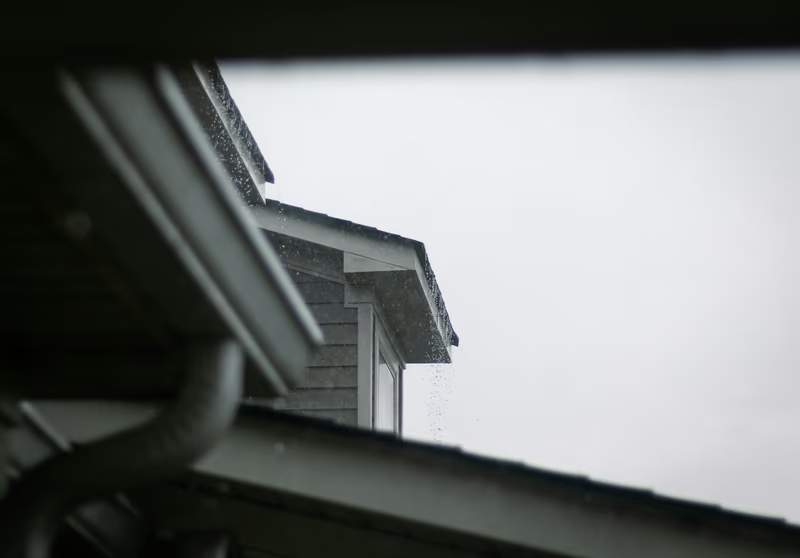
Next time it rains hard, put a coat on and walk the outside of the house. Where does water come off the roof, and where does it land? Is any gutter overflowing? Where does it pool against the wall, and where does it run away? Which side of the house has the most water arriving at it?
Fifteen minutes in the rain tells you more about your foundation risk than an hour of reading, including this. It is also, entirely, free.
Short answers
How much water comes off a roof?
A useful rule of thumb is that one inch of rain on a thousand square feet of roof produces roughly six hundred gallons. On a typical Tallahassee house across a year of close to fifty-nine inches, that is tens of thousands of gallons, and every downspout is delivering its share of it to one specific spot on the lot.
Are gutters even necessary in Florida?
They are more useful here than in a drier climate, not less, precisely because of the rainfall volume. Without gutters, roof water sheets off the eave line and lands in a concentrated strip a foot or two from the wall, which is close to the worst possible place to put it. Gutters are only a liability when they are clogged and overflowing in that same strip.
Where should a buried downspout line discharge?
Downslope, well clear of the building, somewhere the water can keep moving away rather than pooling. It also has to leave the property lawfully and not simply become a neighbor's problem, which is a real constraint on tight lots and worth resolving before the trench is dug rather than afterwards.