Ground Conditions
Red Hills Clay and What It Does to Foundations
The Red Hills are red because of clay carried down from the Appalachians during the last ice age. That clay is why houses on the north side of Tallahassee move in a way that houses fifteen minutes south of them do not.
The Red Hills, also called the Tallahassee Hills, are a region of gently rolling hills running roughly a hundred and fifty miles along the Alabama and Georgia borders. The core of the region is Leon County north of the Cody Scarp, extending into Gadsden, Jefferson, Madison, and Jackson counties in Florida and southern Grady and Thomas counties in Georgia. The county high point, two hundred and eighty feet, sits in this northern section, about ten miles north of Tallahassee.
The soil is red clay deposited during the last ice age from the Appalachian Mountains, and the original forest here grew in deep sandy clay. That composition is the whole story for foundations, because clay is the one common soil constituent whose volume depends on how much water it is holding.
How clay moves a house
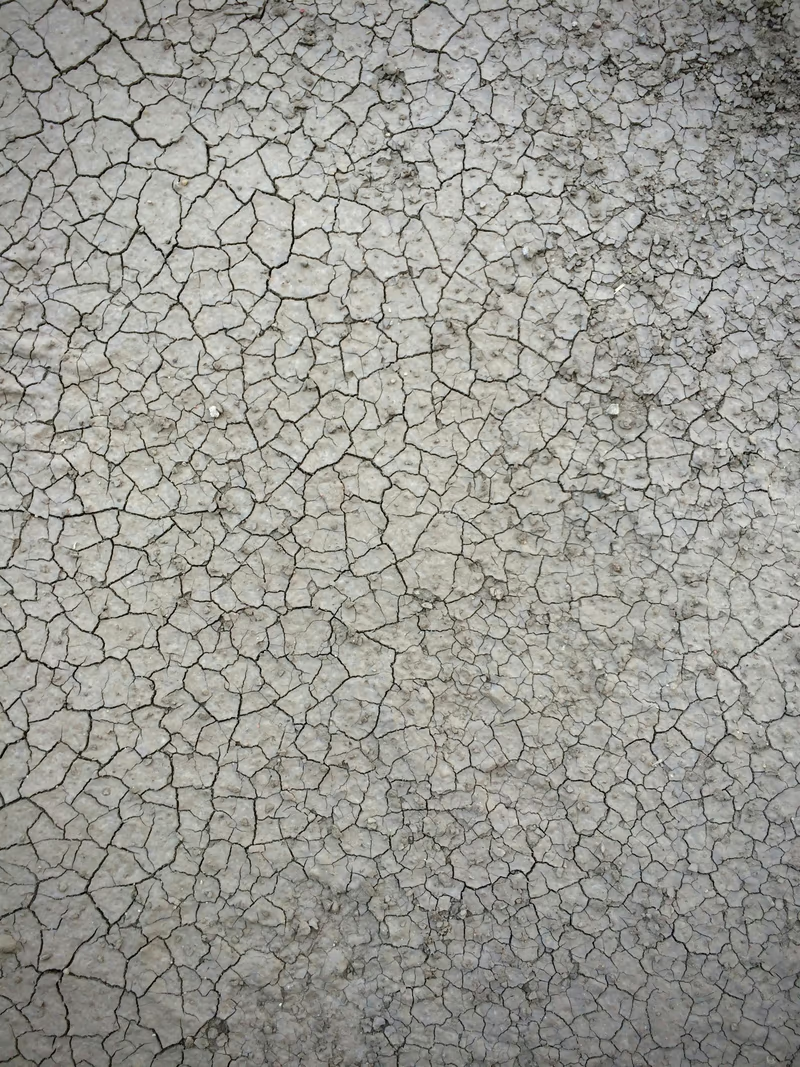
Clay minerals hold water between their particle layers. Add water and the soil expands. Take water away and it contracts. On a soil with high clay content this can be dramatic; on clay-bearing soils like these it is modest per cycle. The problem is not the size of any single movement, it is that the movement is never uniform across a building footprint.
A house has soil under all of it, but water does not arrive evenly. Roof water concentrates wherever the downspouts discharge. One side of the house is shaded and stays damp; the other bakes. A large tree pulls moisture hard out of one corner and nothing out of the rest. The result is that one part of the soil under the slab is expanding while another is contracting, and the slab, which is a rigid plate, has to accommodate the difference by bending. Bending is what cracks it.
The Tallahassee rainfall cycle is the engine
Tallahassee takes close to fifty-nine inches of rain a year, and the distribution matters more than the total. June is the wettest month at around seven and three quarter inches. November is the driest at about three. That is a substantial annual wet-dry cycle running continuously on soil that responds to it.
This is why the signature pattern north of the scarp is seasonal rather than steady. Doors that bind through late summer when the soil is swollen, then swing freely by late autumn as it dries back. Homeowners often report the problem, then report it resolved, then report it again the following year, and conclude the house is fine. Frequently it is. What separates seasonal cycling from actual settlement is whether the house returns to the same place each year, which is exactly what a repeat floor elevation survey measures.
Trees, which are a bigger factor here than people expect
Tallahassee is a heavily canopied city; the designated canopy roads are one of its defining features, and mature live oaks, hickories, and pines are everywhere in the older neighborhoods. A large tree in leaf moves a very large volume of water out of its root zone every day of the growing season, and stops entirely when it rains hard.
On clay-bearing soil that creates a localised moisture swing precisely where the roots run, and a mature tree close to a slab is a well-documented contributor to one-sided settlement. The complication is that removing it is not automatically the fix: soil in a root zone that has been kept dry for decades can take water back on and heave once the demand stops, which moves the foundation in the opposite direction. Tree decisions near a foundation are worth taking slowly and with advice.
Slope, cut, and fill
The rolling terrain adds a second mechanism that flat sandy ground does not have. Where a lot has been cut into a slope and filled to create a level building pad, part of the house sits on undisturbed soil and part sits on placed fill. Fill consolidates for years after construction unless it was compacted properly in lifts, and the two halves settle at different rates. The crack pattern follows the boundary between them almost exactly, which makes it one of the more legible problems to diagnose and one of the more expensive to leave alone.
Sloped lots also mean surface water is always going somewhere, and the uphill side of a house cut into a hillside stays wetter for longer after storms. Areas like Bradfordville and Miccosukee show this pattern regularly.
What repairs look like on this side of the scarp
Three things follow from clay-bearing soil on rolling ground.
- Drainage does more than anywhere else. Because the mechanism is moisture-driven, controlling moisture addresses the cause rather than the symptom. Restoring grade and running roof water properly clear is the first intervention worth making, and it sometimes ends the story. See drainage and grading.
- Piers go deeper. Competent bearing sits further down under deep clay than under thin sand over limestone, so per-pier costs run higher on this side of the county. That difference shows up directly on the quote, which is why assumed depth matters so much in this market.
- Patience is rewarded. Movement driven by a seasonal cycle needs to be observed across at least one full cycle before anyone can tell you whether it is cycling or progressing. Monitoring is not procrastination here, it is the diagnostic.
What this is not
It is worth being clear about the limits. These are not the highly plastic expansive clays that drive foundation engineering in central Texas, and a contractor describing Tallahassee soil in those terms is either working from a national script or overselling. Equally, the sinkhole framing that dominates central Florida foundation marketing does not describe the Red Hills either; karst features here are a feature of the plain south of the scarp and of specific locations like Lake Jackson, not of the clay uplands generally.
What you have on the north side of Leon County is soil that moves modestly, seasonally, and unevenly, on ground that slopes. That is a manageable and well-understood set of conditions, and the repairs for it are ordinary. It is only expensive when it is ignored for a decade.
Short answers
Is Tallahassee clay as bad as Texas clay?
No, and the comparison misleads people in both directions. Red Hills soils are clay-bearing and do change volume with moisture, but they are not the highly plastic expansive clays that dominate foundation engineering in central Texas and Oklahoma. The movement here is slower and smaller. It is also cumulative, and over a decade with poor drainage it is enough to matter.
Should I water my foundation during a dry spell?
It is a real technique on genuinely expansive soils and it is more often mishandled than helpful here. The goal in any soil-moisture strategy is consistency, not saturation, and inconsistent hand watering can create exactly the uneven condition you are trying to avoid. Restoring grade and getting roof water away from the house achieves the same consistency far more reliably.
How do I know if I am on Red Hills soil?
Rough guide: hilly ground north and east of central Tallahassee, above roughly a hundred feet of elevation, on the upland side of the Cody Scarp. If your yard has real slope to it, if the subsoil turns up orange-red when you dig, and if you are north of the city center, you are almost certainly in it.